Best Tools for Multi-Touch Attribution in 2026

Best Tools for Multi-Touch Attribution in 2026
I’d start with revenue records - not ad-platform conversion totals. Across these 6 tools, my first pick for payment-linked Meta Ads reporting is LeadTrak.io. Before choosing, ask each vendor to trace an ad click to a paid sale and show how it handles refunds and unmatched payments.
The right fit depends on what you sell. I compare CRM and payment connections, offline sales, attribution models, and agency support - not just reported conversions.
Quick Comparison
| Tool | Best fit | Main focus | What I’d check |
|---|---|---|---|
| LeadTrak.io | Lead-based businesses and agencies | Payment-linked Meta Ads reporting | Payment connectors and ad-to-payment records |
| Ruler Analytics | B2B and service businesses | Calls and forms tied to CRM revenue | CRM integrations and multi-session reporting |
| Hyros | High-ticket funnels | Ad and call journeys tied to sales | Integrations and attribution windows |
| Northbeam | High-volume ecommerce | Modeled attribution and incrementality testing | Store and subscription billing support |
| Triple Whale | Shopify brands | Shopify orders and ad reporting | Order reconciliation and renewal tracking |
| Wicked Reports | Subscription and repeat-purchase businesses | Recurring revenue and lifetime value | Billing integrations and cohort reporting |
My final check: <u>revenue tracking and multi-touch attribution are not the same thing</u>. I’d ask vendors to show how they divide credit across touchpoints, separate observed data from estimates, and confirm pricing, privacy requirements, and client-account limits. A recorded sale shows revenue; attribution alone doesn’t prove an ad caused it.
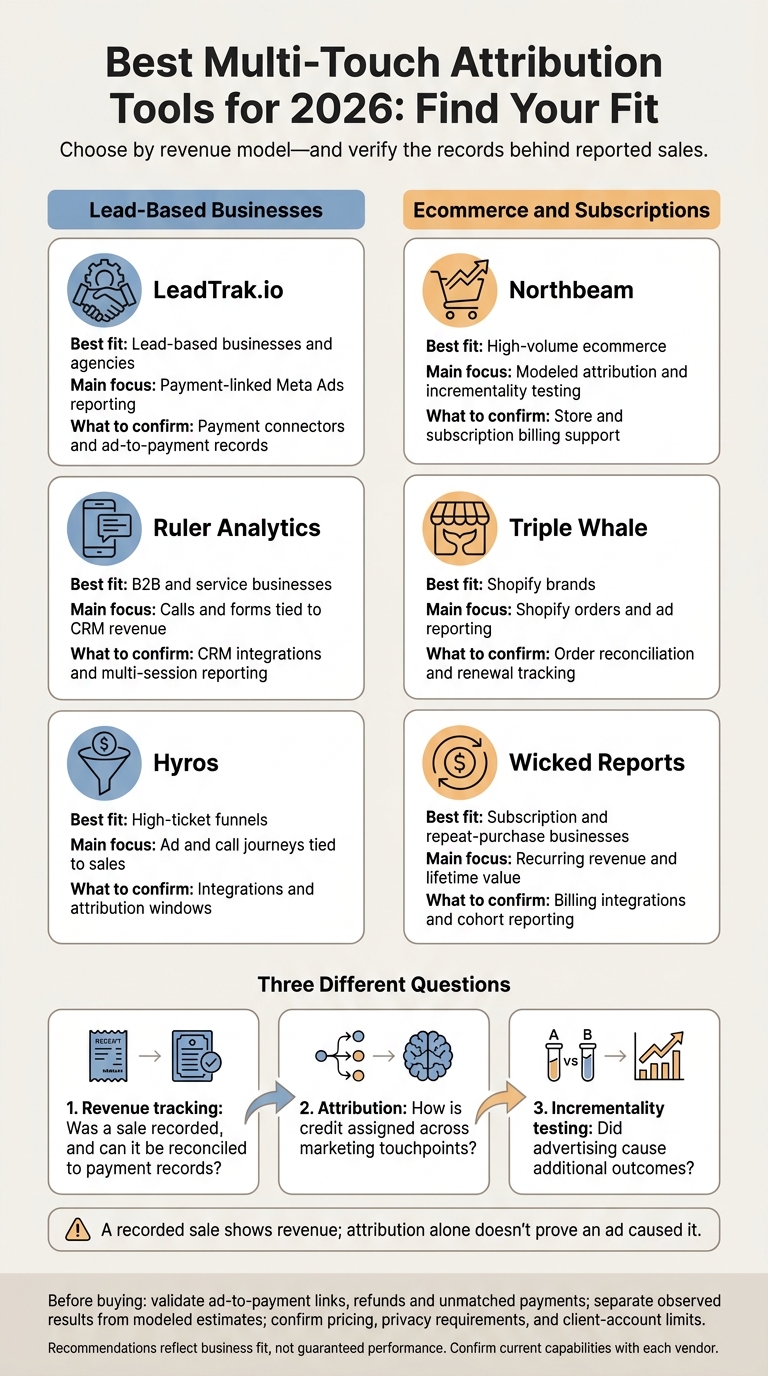
Best Multi-Touch Attribution Tools for 2026: Find Your Fit
2026 Attribution Tools Compared
These tools differ most in how directly they connect Meta Ads to verified revenue. Use this comparison to find the best fit for your business model.
| Tool | Business fit | Meta Ads connection | CRM and payment support | Offline revenue | First-touch / last-touch reporting | Confirmed vs. modeled attribution | Agency support |
|---|---|---|---|---|---|---|---|
| 1. LeadTrak.io | Lead generation businesses and agencies | Server-side CAPI sync and offline conversion tracking | Forms and CRM integrations via WordPress, GTM, and Zapier; payment connector coverage - | Offline conversion tracking | - | Payment-verified attribution | Multi-account management; white-label options - |
| Ruler Analytics | B2B and service businesses | Closed-loop revenue reporting | Salesforce, HubSpot, and Pipedrive | Calls and forms tied to CRM revenue | Multi-session journeys; endpoint reporting - | CRM-linked attribution | Agency reporting; account limits - |
| Northbeam | Scaling ecommerce brands and enterprise data teams | ML-based multi-touch attribution and incrementality testing | Shopify and other ecommerce integrations via API; CRM coverage - | - | - | Modeled attribution with incrementality testing | - |
| Triple Whale | Shopify-based DTC brands | Triple Pixel and CAPI | Native Shopify order data; broader CRM coverage - | - | - | Order-verified attribution | - |
| Wicked Reports | Subscription and recurring revenue businesses | Extended attribution windows, up to 2 years | Salesforce, HubSpot, ActiveCampaign, and Shopify | CRM revenue and recurring purchases | - | CRM-linked attribution | - |
| Hyros | High-ticket funnels, coaching, and information products | Print Tracking and server-to-server connections | HighLevel, Salesforce, and call-tracking integrations; payment processor coverage - | Call-led sales journeys | - | First-party tracking-based attribution | - |
Verification note: An em dash ( - ) means the supplied material does not confirm that detail.
How We Evaluate the Tools
Start with the payment record, not the attribution label. Check how directly each tool links a sale to a specific payment. Does “sale” mean a paid invoice, a Shopify order, or just a CRM deal marked won? Review the underlying record, how the tool handles refunds, and any revenue it can't match.
Test the full Meta Ads setup. Check how campaign and ad IDs reach your CRM and how later payments connect to customers. Also confirm whether sending sales outcomes back through Conversions API needs another integration. Focus on the revenue metric that matches your business: paid cost per job, closed-sale revenue, or recurring revenue.
Check the models - and their limits. First-touch and last-touch reports credit the first and final touchpoints. Multi-touch models divide credit across interactions. Neither establishes causation; incrementality testing is designed to test it [1][3]. Confirm current prices, available models, attribution windows, account limits per client, and setup and integration fees directly with each vendor.
sbb-itb-db0d145
Best Attribution Tools for Lead-Based Businesses
1. LeadTrak.io: Best for Payment-Linked Meta Ads Reporting
LeadTrak.io suits lead-based businesses that want to link Meta Ads to verified CRM revenue.
| Review field | Product details and buyer checks |
|---|---|
| Attribution approach | Starts with payment data, captures fbclid server-side, and connects ad clicks to verified revenue.[2][4][5] |
| Key integrations | Check current CRM and payment connectors, plus setup requirements, before buying. |
If your revenue journey starts with a call or form rather than a tracked payment, consider tools that connect those interactions to sales.
2. Ruler Analytics: Best for Calls, Forms, and Sales Pipelines
Ruler Analytics suits lead-based businesses that need to connect calls, forms, and live chats to CRM revenue. Check the vendor documentation for CRM, call-tracking, and chat integrations, how the tool links sales revenue, and pricing.
For longer sales cycles, look at tools built for high-ticket buying journeys.
3. Hyros: Best for High-Ticket Sales Funnels
Hyros suits businesses with long, high-ticket funnels and info products that need to connect ad touchpoints to sales revenue. Check the vendor documentation for integrations, attribution support, and pricing.
Best Attribution Tools for Ecommerce and Subscriptions
For ecommerce and subscription brands, attribution is less about lead quality and more about order quality. It should tie marketing activity to orders, renewals, refunds, and cancellations.
These three tools differ most in how they measure orders, renewals, and repeat revenue.
4. Northbeam: Best for Ecommerce Attribution Modeling
Best fit: High-volume ecommerce brands. Northbeam uses machine learning and incrementality testing to model which touchpoints drive revenue. Subscription brands should check support for their billing platform before choosing it.[1][3]
5. Triple Whale: Best for Shopify Reporting
Best fit: Shopify brands that want Shopify reporting and ad creative reporting. Triple Pixel combines browser and server-side measurement with actual Shopify orders. But customer labels - such as new, returning, and reactivated - don't track renewals on their own.[1][3][6]
6. Wicked Reports: Best for Order Attribution and Lifetime Value
Wicked Reports focuses on repeat purchases, subscriptions, and cohort lifetime value (LTV), with attribution windows of up to two years.[1][3][5] Its multi-touch attribution links marketing touchpoints to repeat revenue through Shopify, WooCommerce, CRM, and email integrations. One distinction to keep in mind: cohort LTV measures accumulated revenue, not profit.[1][3][5]
Conclusion: Choose Based on Revenue Data and Business Fit
LeadTrak.io is our top choice for payment-verified Meta Ads reporting. Pick a tool that fits your revenue model - not just the conversion totals shown by the platform.
Use the table below to compare tools by revenue model and data source.
Decision Table: Which Tool Fits Your Needs?
These recommendations reflect tool fit, not guaranteed performance.
| Requirement | Recommended tool | What to confirm |
|---|---|---|
| Payment-linked Meta Ads reporting | LeadTrak.io | Payment-to-customer links, revenue metrics, and unmatched revenue labels |
| Calls and pipeline revenue | Ruler Analytics | Multi-session tracking and call attribution to CRM revenue |
| Ecommerce modeling | Northbeam | ML-powered attribution and incrementality testing |
| Shopify reporting | Triple Whale | Shopify order reconciliation and ad-spend reporting |
| Order attribution and lifetime value | Wicked Reports | Cohort tracking for recurring revenue |
| High-ticket journeys | Hyros | Long-window call attribution |
Checklist Before Choosing an Attribution Tool
Test the tool against your own customer journey before committing. Check how it assigns credit across touchpoints. Ask the vendor to show your required model - such as linear, time-decay, or position-based - then reconcile the results with actual payments.
- [ ] Validate ad-to-payment links against your records.
- [ ] Check revenue and profit inputs, including fees and refunds.
- [ ] Review unmatched payments and confirm that you can audit and reverse changes.
- [ ] Verify first-touch, last-touch, and multi-touch credit allocation.
- [ ] Check support for jobs, enrollments, deals, or MRR, plus separation of client data.
- [ ] Separate observed results from modeled estimates.
- [ ] Confirm privacy requirements, setup costs, recurring fees in USD, and plan limits before signing.
FAQs
How much data do I need for multi-touch attribution?
The information provided doesn’t state a minimum data volume. Instead, it focuses on connecting first-party data across the customer journey, from ad clicks to CRM outcomes and payments.
For Meta Ads, server-side tracking connects these records and sends enriched closed-deal conversion data back to Meta, often through Conversions API. That lets Meta optimize for revenue, rather than pixel activity or form fills.
How can I validate attribution before changing ad budgets?
Use server-side tracking to send real outcomes - not just form fills - back to Meta through Conversions API. This helps optimization and reporting reflect revenue and closed deals across the full funnel.
LeadJourney supports this with multi-touch attribution and closed-deal tracking, including cost per close. It records Facebook click IDs (fbclid) server-side and sends won deals back to Meta.
How do privacy restrictions affect attribution accuracy?
Privacy restrictions can leave gaps in attribution. That’s why confirmed revenue needs to stay separate from unverified revenue. LeadTrak connects ad accounts, CRMs, payment processors, and website forms to link payments to customers and their sources. When a payment has no matching lead, it gets the label “No lead found” - not an assumed source. This helps businesses make budget decisions based on verified revenue.