How Creative Impacts ROAS In Meta Ads
How Creative Impacts ROAS In Meta Ads
The success of Meta Ads in 2026 hinges on one key factor: the quality of your ad visuals and messaging. With Meta's AI automating targeting, placements, and bidding, your focus should be on creating ads that grab attention, keep viewers engaged, and drive clicks. Here's why this matters:
- Creative quality drives up to 47% of ad performance variability. Top-performing ads can deliver 5–8x higher ROAS than weaker ones.
- Metrics like hook rate, hold rate, and CTR are critical. Ads with a hook rate below 25% or hold rate under 10% struggle to compete.
- Testing is essential. Structured testing of concepts and hooks boosts ROAS by 28%.
To stay ahead, focus on testing big ideas, monitoring engagement metrics, and refreshing ads regularly to avoid fatigue. Even minor tweaks, like changing the first three seconds of a video, can improve results. The bottom line? Your ad visuals and messaging are the most powerful tools to achieve better ROAS.
Creative Metrics That Drive ROAS
Meta Ads Creative Performance Metrics: Hook Rate, Hold Rate, and CTR Benchmarks
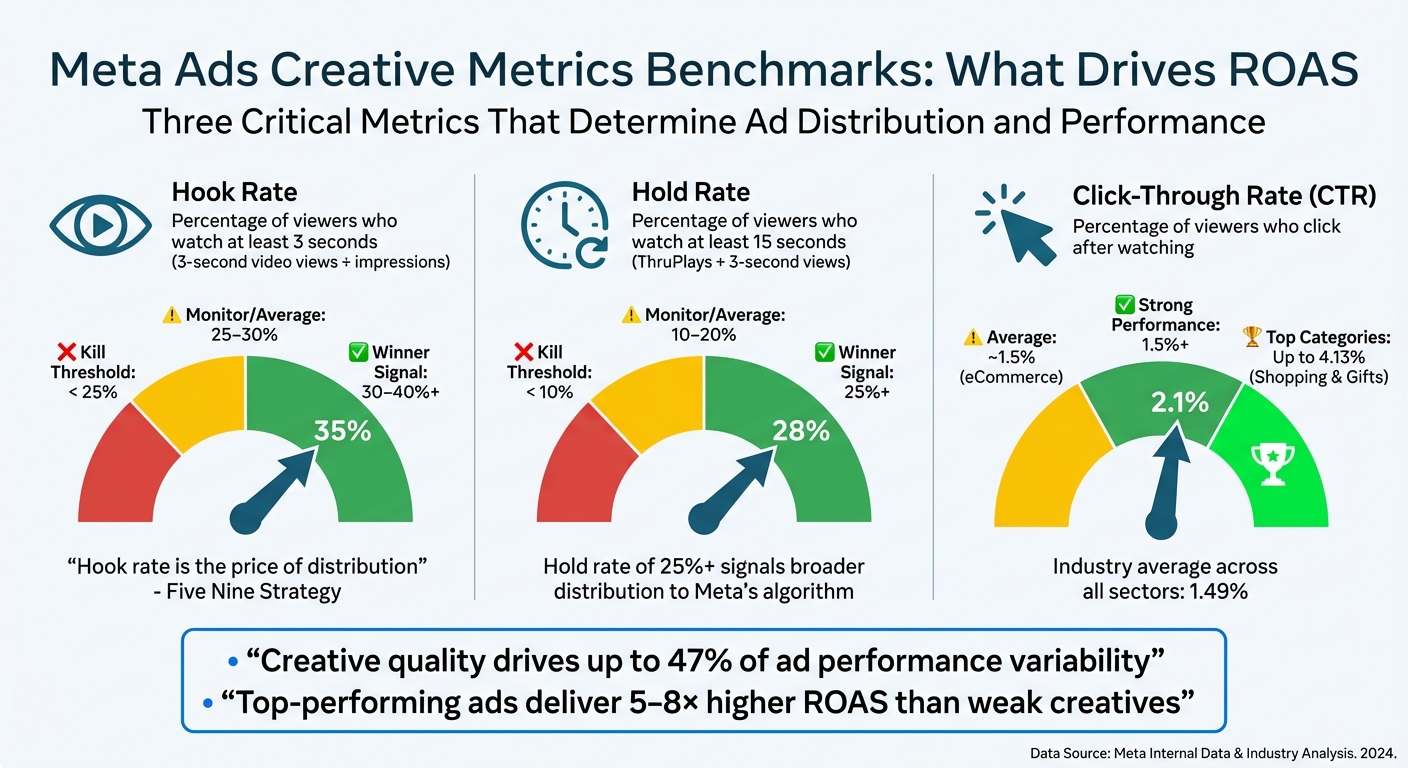
Meta's algorithm doesn’t rely on conversion data to decide which ads should be distributed. Instead, it evaluates early engagement signals to predict an ad's performance and allocate impressions accordingly. These signals play a key role in determining ROAS (Return on Ad Spend). The three metrics you need to focus on are hook rate, hold rate, and click-through rate (CTR). These metrics decide whether your ad gets wide distribution at a lower cost or is removed from the auction entirely. Let’s dive into how each metric impacts ad performance and ROAS.
Hook Rate and Ad Performance
Hook rate measures the percentage of viewers who stick around for at least the first three seconds of your video (calculated as 3-second video views divided by impressions). Five Nine Strategy describes it well:
"Hook rate is the price of distribution" [4]
For most direct-to-consumer brands, a hook rate of 25–30% is common, while the best campaigns aim for 30–40% or higher [4][5]. Mobile game advertisers often target a hook rate of 30% or more [5]. Ads with strong hook rates tend to secure more impressions at lower CPMs. On the flip side, a hook rate below 25% suggests the ad might struggle to compete in the auction [3][6].
Hold Rate and Viewer Retention
Hold rate tracks the percentage of viewers who watch at least 15 seconds of your video (ThruPlays divided by 3-second views). While a good hook rate gets your ad into the auction, a hold rate of 25% or higher signals to Meta’s algorithm that your content keeps viewers engaged and deserves broader distribution [2][3]. If you notice a high hook rate but a low hold rate, it’s a sign your ad grabs attention initially but loses viewers midway. This could mean the middle section of your ad needs tweaking.
Click-Through Rate (CTR) Benchmarks
CTR measures how many viewers click on your ad after watching it. For eCommerce brands, a CTR above 1.5% is considered strong, while the average across industries hovers around 1.49%. Some categories, like Shopping & Gifts, see CTRs as high as 4.13% [2]. As a downstream metric, CTR reflects how well your ad resonates with an already engaged audience. A high CTR paired with strong conversion rates is a reliable indicator of improved ROAS. However, if clicks don’t lead to conversions, it might point to a disconnect between your ad’s messaging and the landing page [2].
| Metric | Kill Threshold | Monitor/Average | Winner Signal |
|---|---|---|---|
| Hook Rate | < 25% | 25–30% | 30–40%+ |
| Hold Rate | < 10% | 10–20% | 25%+ |
| CTR (eCommerce) | N/A | ~1.5% | 1.5%+ |
sbb-itb-db0d145
How Creative Quality Affects Conversion Metrics
Creative quality plays a pivotal role in turning initial engagement into conversions. Once viewers are drawn in, the effectiveness of your creative determines whether they take the next step. Metrics like CPA, conversion rates, and ROAS are all influenced by how well your creative resonates with the audience.
Creative Quality and CPA
Strong creatives don't just look good - they actively impact performance metrics. Meta’s algorithm favors ads with high engagement, which can lead to lower CPMs and, in turn, reduce your Cost Per Acquisition (CPA). Ads that hook viewers and keep their attention are rewarded with better auction placement, creating a smoother path to conversions.
Here's a compelling example: A health supplement brand in 2025 tested 12 hooks and eight creative variations on Reels. Through this process, they identified a “before-and-after testimonial” as their top-performing format. The result? Their CPA dropped from $75.48 to $44.24, revenue scaled by 2.3×, and they achieved a 3.4 ROAS [8]. Advertisers running five or more creative variations per ad set report CPAs that are 20–30% lower compared to those using just one or two [3]. This highlights the importance of testing broader creative concepts rather than focusing solely on minor design tweaks. Lower CPAs driven by strong creative quality directly contribute to better ROAS outcomes.
Creative Impact on Conversion Rates
Great visuals and messaging do more than attract attention - they convert. Following creative best practices can lead to measurable sales growth, with long-term sales increasing by 1.2× to 2.7× and short-term sales rising by 1.2× to 7.4× [1]. Using a mix of formats like 9:16 video, audio, and storytelling has been shown to lower CPA by 16% and increase conversion rates by 29% [8].
However, if you’re seeing high click-through rates but low conversions, your creative might be misaligned with your landing page. This often happens due to “curiosity clicks,” where users are intrigued enough to click but not committed to converting because the messaging doesn’t match the offer [2]. Aligning your creative with your landing page offer is key to turning clicks into actual conversions.
ROAS Differences Between High and Low Quality Creatives
The quality of your creative can make or break your ROAS. Creative quality accounts for nearly half (47%) of ad performance variability, and top-performing creatives often deliver ROAS that is 5–8× higher than the worst-performing ones in a test [3]. That’s a massive difference when it comes to profitability.
For context, the median Facebook ROAS across thousands of advertisers is about 2.19:1. However, campaigns that combine Facebook and Instagram tend to average a higher ROAS of 3.8:1 [7]. Brands that outperform these benchmarks aren’t just spending more - they’re prioritizing creative quality that drives meaningful engagement and conversions. Investing in better creative doesn’t just improve metrics; it sets the foundation for scalable, profitable growth.
Managing Creative Fatigue to Maintain ROAS
Every ad has a shelf life. Over time, audiences grow tired of seeing the same creatives, leading to creative fatigue - a phenomenon that can seriously hurt your Return on Ad Spend (ROAS). Spotting and addressing this issue quickly is key to keeping your campaigns profitable.
Signs of Creative Fatigue
The first indicator of fatigue is often a decline in Click-Through Rate (CTR). A 10% drop in CTR over a week suggests early fatigue, while a 20% drop over two weeks calls for immediate action [10]. Keep an eye on your Cost Per Acquisition (CPA), too - it can increase by 15% in early stages and spike by 30% if fatigue persists [10].
Frequency is another critical metric. For prospecting campaigns, fatigue tends to set in when frequency hits 2.5–3.5. Retargeting campaigns, however, have a bit more leeway, with fatigue kicking in around 4.0–6.0 [10][12]. Research shows that about 19% of Meta ad impressions are seen by the same user more than five times, and conversion likelihood drops by 45% after four exposures [11].
"Fatigue is a behavioral response - your audience has mentally 'filtered out' your ad. They've processed the message... and their attention moves on." - Adligator Team [9]
Fatigue doesn’t just impact one ad - it can affect all campaigns using the same visuals. When engagement drops, Meta’s algorithm may hike your CPMs or target less optimal audience segments to maintain delivery, further diminishing ROAS [9]. This is when a structured creative rotation becomes essential.
Creative Rotation Methods
The answer isn’t simply creating more ads - it’s about having a system in place. A 3-Tier Pipeline is a great approach:
- Tier 1: Actively run 3–5 creatives.
- Tier 2: Keep 5–10 approved concepts ready to go.
- Tier 3: Continuously develop new ideas based on performance data [9].
This setup ensures you’re always prepared to swap out fatigued creatives without scrambling. A good rule of thumb is to produce one new creative for every $1,000 of daily ad spend [12]. So, if you’re spending $5,000 daily, aim for at least five new creatives to keep your campaigns fresh.
You don’t always need to start from scratch. Iterative refreshes - like tweaking the first three seconds of a video, changing background colors, or updating text overlays - can breathe new life into successful ads [10]. Adding new creatives to fatigued ad sets has been shown to boost conversion rates by an average of 8% [11]. Another option is format rotation, where you alternate between static images, carousels, videos, and user-generated content. Even if the message stays consistent, the visual change can re-engage your audience [9][10].
The "Pulse" strategy is another effective method. Instead of running all ads nonstop, rotate batches of 10 creatives every two weeks. For example, pause Batch A and launch Batch B. By the time Batch A returns in Week 5, your audience will have “forgotten” the earlier ads [12]. You can also set up automated rules in Meta Ads Manager to alert you when CTR drops below a set threshold (e.g., 1.5%) or when CPA exceeds your break-even point by 25% over three days [9].
Finally, consider using founder-led or team-based content. A study by MHI Media in February 2026 examined 50 brands scaling past $20,000 per month. Brands that incorporated founder-led content saw their creatives last an average of 38 days - compared to the typical 30-day lifespan - and experienced an 18% lower CPM as Meta rewarded the authenticity [12]. Audiences often perceive this type of content as a “story” rather than an ad, which can extend its effectiveness by 28% [12].
Testing and Optimizing Creatives for Higher ROAS
As we’ve explored, the quality of your creatives has a direct impact on ROAS. But to truly capitalize on this, you need a systematic testing approach. Research shows that advertisers using structured testing processes see a 28% higher ROAS compared to those who test without a clear plan [3].
"Creative testing is the single most important ongoing activity for Meta Ads performance in 2026." - RedClaw Performance Team [3]
The key is to test creative elements in a specific order. Start with high-impact factors like the concept or angle, which can influence ROAS by as much as 3–8x. From there, refine components like the hook, format, and offer before focusing on smaller details [3].
Creative Testing Methods
A/B testing is the gold standard for determining which concepts work best. The trick is to change only one variable at a time so you can pinpoint what’s driving results. For example, if you’re testing whether “saving time” or “saving money” resonates more, keep everything else - like visuals, format, and CTA - exactly the same [13].
When it comes to video ads, hook-centric testing should be your priority. Those first three seconds are critical for grabbing attention. Experiment with different opening lines, visuals, or questions to figure out what gets people to stop scrolling [3].
The Concept Testing Ladder is another helpful framework. Begin with broad ideas, like comparing pain points versus social proof, and then move toward testing specific formats or executions. This ensures you don’t waste time or money fine-tuning ideas that don’t connect with your audience [13].
Using an Audience-Creative Matrix is also a smart move. This method pairs creative variations with specific audience segments, helping you uncover patterns - for example, founder-led content might perform best with new audiences, while product demos work better for retargeting [13].
For high-volume accounts, rapid iteration testing speeds up the learning process. Launch 10–15 variations with smaller daily budgets and look for performance signals within 48–72 hours. Ads with less than a 0.5% CTR or poor performance after 1,000 impressions should be paused, with their budgets reallocated to stronger performers [3][13].
Finally, don’t jump to conclusions too early. Wait until an ad reaches at least 1,000 impressions and 10–30 conversions before declaring a winner. Acting prematurely can lead to wasted spend and misleading results [3].
| Metric | Kill Threshold | Winner Signal |
|---|---|---|
| CTR | Below 0.5% | Above 1.5% |
| CPA | 2x target after 7 days | Below target |
| ROAS | Below 1.5x | Above 3x |
| Conversion Rate | Below 1% | Above 4% |
| ThruPlay Rate | Below 10% | Above 25% |
Data-Driven Optimization Frameworks
Once you’ve identified winning creatives, use data-driven frameworks to scale their success. The 10-5-2 pipeline is a reliable way to keep your creative process on track: maintain 10 concepts in ideation, 5 in production, and 2 ready to launch at any given time [3]. This approach prevents performance dips caused by creative fatigue, which typically sets in every 2–4 weeks [3].
A Winners Library is another valuable tool. Save elements like headlines with consistently high CTRs or hooks that achieve strong ThruPlay rates. These proven components can help you develop future campaigns more efficiently [13].
The iterative testing loop includes six stages: Ideate, Produce, Test, Analyze, Iterate, and Scale [3]. Once a creative achieves strong metrics - like a ROAS above 3x or a CTR over 1.5% - move it to a dedicated “Winners” campaign or an Advantage+ Shopping campaign with a higher budget [3]. Then, refine its successful elements. For example, if a specific hook works well, test variations of it with new visuals or offers.
Keep an eye on metrics like hook rate and hold rate to pinpoint where your creative might be falling short. If the hook rate is strong but the hold rate drops, it’s a sign your ad grabs attention but struggles to maintain it. This suggests you need to improve the middle section of your video [3].
When scaling, focus on high-impact elements first. Testing concepts like pain points or benefits (Level 1) will have a much bigger impact than tweaking minor details like button colors (Level 6) [3].
Lastly, monitor frequency alongside performance metrics. If your CTR starts to drop while frequency rises above 3–4, it’s likely a case of creative fatigue. Instead of scrapping the concept, rotate in fresh creatives from your pipeline to keep performance strong.
At Dancing Chicken, we’ve incorporated these structured testing and data-driven strategies into our Meta Ads services, ensuring consistent ROAS improvements and overall account success.
Conclusion
Every piece of creative work plays a crucial role in the success of Meta Ads. Creative quality stands out as the most critical factor influencing ROAS (Return on Ad Spend). With Meta's AI automating targeting, placements, and bidding, your creative becomes your primary competitive edge. The numbers speak for themselves - top-performing creatives can outperform weaker ones by a staggering 5–8x in terms of ROAS [3].
Research underscores this point. Nielsen attributes 56% of a campaign's sales ROI to creativity, while Google highlights that 70% of a campaign's success depends on the creative [1]. Real-world examples back these findings: Nestlé's 2022 Kit Kat campaign in Spain showed that ads following creative best practices were 12% more effective at driving sales than lower-quality ads [1]. Similarly, BMG360's 2025 test revealed that creator-led Partnership Ads boosted ROAS by 35% and reduced CPA by 19% compared to traditional brand-focused creatives [14].
But even the best-performing ads have a shelf life, as discussed in the creative fatigue section. The solution isn’t about crafting one perfect ad - it’s about implementing a systematic testing process. Advertisers who use structured testing frameworks see a 28% higher ROAS compared to those who test randomly [3]. This approach ensures a steady pipeline of fresh, effective creative.
Focus your efforts on testing big ideas first. Experimenting with different concepts - such as tackling pain points versus using social proof - can shift ROAS by 3–8x. On the other hand, tweaking minor details like button colors yields minimal results [3]. Start with the major elements: your hook, core message, and format.
At Dancing Chicken, we integrate these proven principles into our Meta Ads strategies, enabling businesses to sustain strong ROAS through ongoing creative testing and refinement. By continuously testing and refreshing your creative, you can achieve consistent growth. The takeaway? Your creative is the driving force behind your success.
FAQs
How do I track hook rate and hold rate in Meta Ads Manager?
To monitor hook rate and hold rate in Meta Ads Manager, you can customize dashboards or reports to highlight key engagement metrics.
- Hook rate measures how effectively your ad captures attention. Metrics like Click-Through Rate (CTR) are useful indicators here.
- Hold rate, on the other hand, reflects how long viewers remain engaged. Metrics such as watch time or video completion rates can help assess this.
Additionally, tools like Meta’s A/B Testing and Dynamic Creative Optimization allow you to experiment and analyze these metrics more effectively, giving you insights into what resonates with your audience.
What should I change first if hook rate is high but hold rate is low?
If your hook rate is strong but your hold rate falls short, it's time to focus on making your creative more engaging and relevant. Experiment with key elements such as visuals, messaging, and ad formats. These are critical components for keeping your audience interested and improving your hold rate.
How many new creatives do I need each week to prevent ad fatigue?
Refreshing or rotating your ad creatives every 21–28 days is a smart way to keep your audience interested and engaged. This regular update cycle helps prevent ad fatigue, ensuring your campaigns stay fresh and continue to perform well. By making these adjustments consistently, you maintain your audience's attention and maximize your campaign's effectiveness.