
Incremental Budget Scaling vs. Aggressive Scaling
Incremental Budget Scaling vs. Aggressive Scaling
When scaling Meta Ads campaigns, you have two main approaches: Incremental Budget Scaling and Aggressive Scaling. Here's the key difference:
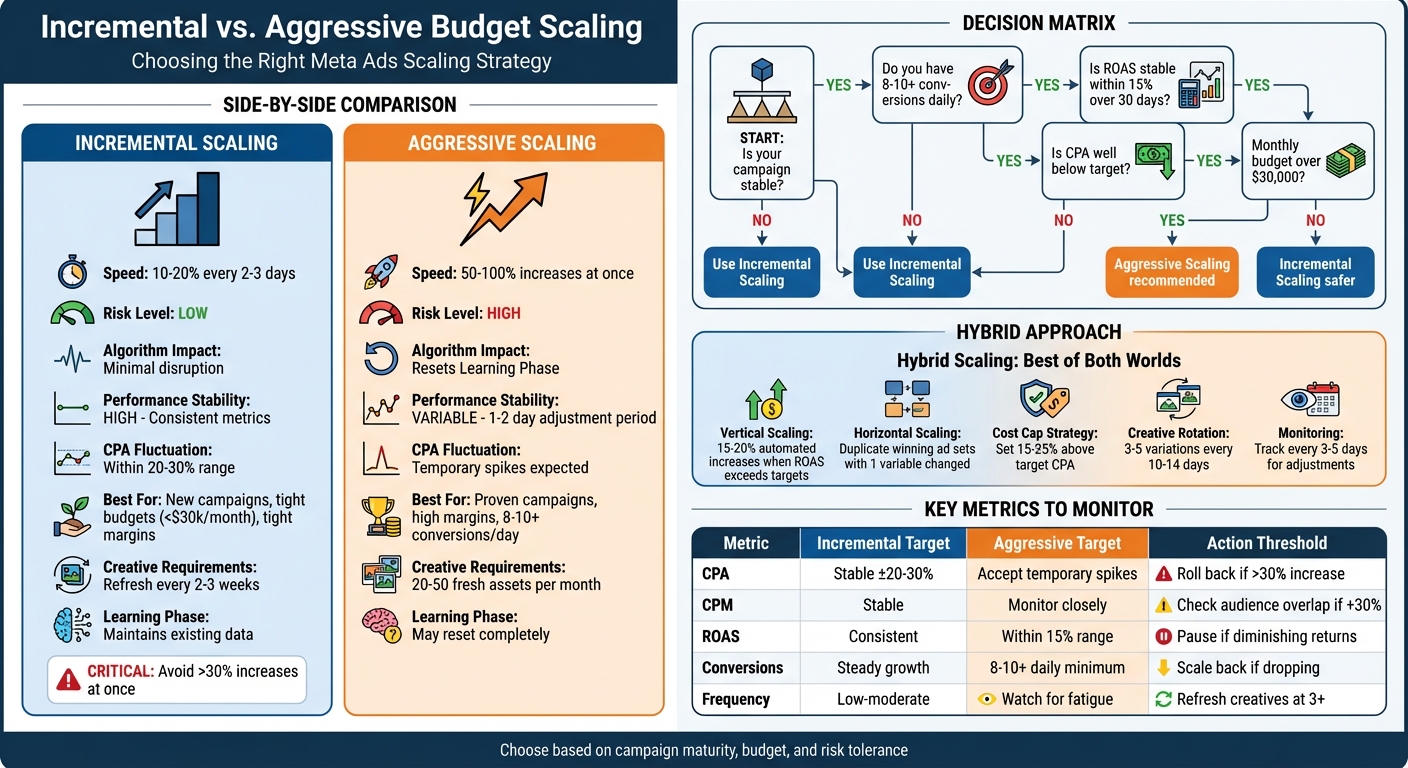
- Incremental Scaling: Gradually increase your budget by 10–20% every 48–72 hours. This method minimizes disruptions to Meta’s algorithm, keeping performance stable. However, it’s slower and might not suit time-sensitive campaigns.
- Aggressive Scaling: Increase budgets by 50–100% at once for faster growth. This approach can deliver quick results but risks resetting Meta’s Learning Phase, leading to temporary performance fluctuations and higher costs.
Quick Comparison
| Feature | Incremental Scaling | Aggressive Scaling |
|---|---|---|
| Speed | Slow (10–20% every 2–3 days) | Fast (50–100% increases) |
| Risk | Low | High |
| Algorithm Impact | Minimal disruption | Resets Learning Phase |
| Best For | New campaigns, tight budgets | Proven campaigns, high margins |
Choose your strategy based on your campaign’s performance, goals, and risk tolerance. Incremental scaling suits cautious growth, while aggressive scaling works for campaigns ready to take on higher stakes.
Incremental vs Aggressive Budget Scaling for Meta Ads: Complete Comparison Guide
Incremental Budget Scaling: Benefits and Drawbacks
Benefits of Incremental Budget Scaling
Incremental scaling offers a controlled way to adjust budgets without disrupting Meta's algorithm. By increasing budgets gradually - around 20% every 3–4 days - you give the algorithm time to adapt. This approach helps maintain a steady cost per acquisition (CPA) and avoids the kind of cost spikes that can hurt your return on ad spend (ROAS). Slow, consistent increases allow the algorithm to collect meaningful data and fine-tune its predictions[2].
"Sudden increases often destabilize performance and hurt ROAS." – Narender Singh, Head of Marketing – Earned Media, DWAO[1]
Before scaling, ensure your top-performing ad sets have shown consistent results for at least 7–14 days[3]. This step ensures you're scaling based on dependable performance rather than short-term success.
While this method keeps things stable, it does come with a tradeoff - it may not be the fastest way to scale.
Drawbacks of Incremental Budget Scaling
The biggest downside to incremental scaling is its slower pace. Waiting 3–4 days between each adjustment can feel frustrating if you're looking to scale aggressively[2][3]. For example, if you're spending $500 a day, a 20% increase adds just $100 every few days, meaning it could take weeks to reach $2,000 daily.
This cautious approach might also cause you to miss out on time-sensitive opportunities, like Black Friday, when competitors may act more aggressively to capture market share[2]. Additionally, incremental scaling requires ongoing attention. To combat ad fatigue, you'll need to refresh your ad creatives every 2–3 weeks to maintain performance[2][3].
Incremental Budget Scaling Comparison Table
Here's a quick look at how key metrics behave under incremental scaling and what actions to take if performance dips:
| Metric to Monitor | Scaling Target/Benchmark | Action if Threshold is Hit |
|---|---|---|
| CPA | Stable within 20–30% range | Roll back budget to previous stable level[3] |
| CPM | Stable | If rising 30%+, check for audience overlap[3] |
Aggressive scaling, which aims for faster growth but comes with higher volatility, will be discussed in the next section.
sbb-itb-db0d145
Aggressive Budget Scaling: Benefits and Drawbacks
Benefits of Aggressive Budget Scaling
Aggressive budget scaling allows businesses to capture market share quickly, often outpacing competitors. By increasing budgets by 50% to 100% at once, you can dominate a specific niche or territory in a short amount of time[6]. This method is particularly effective when campaigns consistently deliver 8–10 conversions per day and maintain a stable CPA over 3–4 days[4].
One major advantage is the potential for higher net profit. When your CPA is low and your profit margins are healthy, temporarily accepting a slightly higher CPA can lead to greater overall profits. As Losid Berberi, Chief Marketing Officer at TheOptimizer.io, puts it:
"If your CPA is low enough and you have enough margin, you can also change it [budget] more frequently in exchange for a slightly higher CPA, lower margin, but higher net profit."[4]
Another benefit is horizontal scaling, which involves duplicating successful ad sets across multiple accounts. This approach helps bypass individual account spending caps and provides a safeguard against account restrictions that could otherwise halt all activity[4]. To minimize risk, it’s best to start with conservative budgets on these new ad set clones to avoid overspending on untested campaigns[4].
While this strategy offers clear advantages, it’s not without its challenges.
Drawbacks of Aggressive Budget Scaling
One of the biggest risks of aggressive scaling is algorithm disruption. Platforms like Meta treat large budget adjustments as significant edits, which can reset the learning phase. This reset often causes temporary CPA spikes for 1–2 days before stabilizing[4]. Rachel Lindteigen highlights this risk:
"Increasing too quickly can cause the ads not to scale because the algorithm needed more time to learn about the ad's performance."[5]
Another downside is the increased likelihood of ad fatigue. Rapid scaling demands a constant supply of new creatives to sustain performance. To keep campaigns running effectively, you’ll need 20–50 fresh creative assets per month[6]. Without this steady stream of new content, performance can drop off quickly, undoing the benefits of the initial budget increase.
Although aggressive scaling can drive rapid revenue growth, its risks - like performance instability and creative burnout - require careful management to avoid long-term setbacks.
Incremental vs. Aggressive Budget Scaling Comparison Table
Here’s a quick look at how incremental and aggressive scaling stack up:
| Feature | Incremental Scaling | Aggressive Scaling |
|---|---|---|
| Speed | Slow and steady (20% every 3–4 days) | Fast growth (50–100% increases) |
| Risk Level | Low - minimal CPA fluctuation | High - temporary CPA spikes expected |
| Algorithm Disruption | Minimal - algorithm adapts gradually | Significant - may reset learning phase |
| Performance Stability | High - consistent metrics over time | Variable - 1–2 day adjustment period |
| Best For | New campaigns, tight margins | Proven winners, high-margin products |
When to Use Incremental Budget Scaling
Best Scenarios for Incremental Scaling
Incremental scaling works well for budgets under $30,000 per month and for campaigns that are just getting started. These situations require a careful approach to protect your learning data and reduce potential risks. By gradually increasing your budget, you ensure that your campaign data remains intact, building on the earlier-discussed advantages of this method.
For new campaigns, slow and steady budget increases allow Meta's models to adapt without being thrown off course. Sudden, large budget jumps force these models to rebuild their predictions from scratch, potentially undoing weeks of valuable learning. This can lead to higher CPAs and disrupt your campaign's performance[7].
Stick to incremental scaling if your campaign is delivering a stable ROAS. If you notice that spending more leads to diminishing returns, it’s better to pause and focus on optimizing your campaign[7].
To maintain performance, set a Cost Cap at 15–25% above your target CPA. For example, if your target CPA is $40, aim for a Cost Cap between $46 and $50[7].
When margins are tight or cash flow is limited, incremental scaling offers a reliable way to achieve steady, predictable growth. It’s an effective approach when you need to balance growth with financial caution as part of your broader scaling strategy.
When to Use Aggressive Budget Scaling
Best Scenarios for Aggressive Scaling
Aggressive budget scaling works best when your campaigns are already delivering steady, reliable results. Before making significant budget increases, ensure your campaign has exited the learning phase and is showing stable performance. A solid foundation is key for handling larger budget jumps.
Here’s what to look for: your campaign should generate at least 8–10 conversions daily, maintain a ROAS within a 15% range over the past 30 days, and consistently spend its full daily budget. If your cost per acquisition is well below your target, you might consider increasing the budget by 50% to 100% to capture more volume and maximize results[4][8].
Creative strategy plays a huge role when scaling aggressively. As spend increases, ads that perform well at lower budgets may lose effectiveness. To avoid burnout, have 3–5 high-performing creatives ready to rotate in. It’s also smart to vary your creative approach - experiment with different hooks, angles, and formats, like Reels or static images. This helps Meta’s algorithm uncover new audience segments and sustain growth[4][8].
Enterprise-level businesses, especially those with strong customer retention and high lifetime value (LTV), are often better positioned to handle the risks of aggressive scaling. These companies frequently use Campaign Budget Optimization (CBO), which allows Meta to automatically shift spend toward the best-performing ad sets in real time[8].
However, scaling without a solid campaign foundation can lead to failure. Studies show that aggressive scaling is only effective when tracking is accurate, conversion volume is consistent, and performance metrics are stable. If these elements aren’t in place, it’s wiser to take a gradual approach until your campaigns are ready for larger budget increases[8].
Hybrid Scaling: Combining Both Approaches
Hybrid scaling blends incremental and aggressive methods, tailoring the approach to your campaign's changing needs. It strikes a balance between the safety of gradual budget increases and the potential for growth through larger, calculated jumps.
The key is to pair automated vertical scaling with human-guided horizontal expansion [9]. For example, when a successful ad set starts showing signs of audience saturation - like rising costs per acquisition or high frequency - you can shift from vertical to horizontal scaling [10]. This way, your system remains dynamic, continuously renewing itself rather than relying on the prolonged success of a single campaign [7].
How to Implement Hybrid Scaling
To execute this balanced strategy, follow these steps:
- Start with automated vertical scaling: Use daily budget increases of 15–20% when your ROAS exceeds target thresholds over a 3-day lookback period [9]. Avoid increasing budgets by more than 30% at once, as this can disrupt the algorithm and restart the learning phase [9][10].
- Graduate successful campaigns: Use the "winners graduation" method to move campaigns through tiers. Experimental campaigns (Tier 3) that perform well can move into growth testing (Tier 2), and eventually into your core performer tier (Tier 1) when they sustain strong results under higher budgets [7]. Ensure each ad set achieves at least 50 weekly conversions before scaling to give the algorithm enough data to optimize [10].
- Trigger horizontal scaling when vertical scaling stalls: Duplicate ad sets and alter one variable, like testing a broader lookalike audience or introducing new creative elements [10]. To combat ad fatigue, roll out 3–5 fresh creative variations every 10–14 days. For high-spend accounts, consider increasing this to 5–10 variations per week [7][9].
- Control costs with a flexible buffer: Set a cost cap 15–25% above your target CPA. This gives the algorithm room to find conversions without allowing costs to spiral [7]. Use audience overlap tools during horizontal scaling to ensure your new ad sets aren't competing with each other [10].
- Track performance carefully: With privacy changes expected to leave 20–30% of conversions unattributed by 2025, precise tracking is more important than ever for making informed scaling decisions [9]. Avoid making adjustments while campaigns are still in the learning phase; wait for stability before scaling [9][10].
At Dancing Chicken, we use these hybrid scaling techniques to get the most out of Meta Ads. By combining automation with human oversight, we aim to drive consistent and sustainable growth.
Scaling Strategy Decision Table
| Campaign Stage | Recommended Approach | Budget Caps | Monitoring Cadence |
|---|---|---|---|
| Testing | Horizontal (New audiences/creatives) | Low ($50–$100 minimum) | Daily (Check for winners) |
| Scaling | Vertical (Incremental increases) | High (Based on ROAS targets) | Every 3–5 days (Adjustments) |
| Plateau | Hybrid (New horizontal segments) | Moderate (Spread across sets) | Daily (Watch for spikes) |
Conclusion
Deciding between incremental and aggressive budget scaling isn’t about choosing one over the other - it’s about aligning your approach with your campaign’s performance and your business objectives. Incremental scaling works best for campaigns in their early stages or those operating within tight budgets. On the other hand, aggressive scaling is more suitable for campaigns that already have proven creatives and well-defined audiences.
Each method has its own strengths and risks, which makes it essential to base your strategy on how your campaign is performing. Many top advertisers rely on marginal ROAS (Return on Ad Spend) to determine the right time to shift strategies - from vertical scaling to horizontal expansion. This metric provides clarity on when to adjust your approach, whether it’s time to scale back or explore new audiences.
To refine your approach, consider testing horizontal expansion for new opportunities while using vertical increases to grow your winning campaigns. Stay flexible and adapt your strategy as results shift.
Still unsure? Dancing Chicken specializes in data-driven Meta Ads strategies designed to increase your revenue. By combining automated scaling tools with expert oversight, we help you maximize your ROAS and eliminate wasted spending.
A well-executed scaling strategy can transform your campaigns from stagnant to thriving. Keep an eye on the right metrics, stay adaptable, and don’t hesitate to seek expert advice when needed.
FAQs
How do I know when a campaign is ready for aggressive scaling?
When a campaign maintains stable performance for 3–7 days while meeting or surpassing your target ROAS or CPA benchmarks, it’s a sign it’s ready for aggressive scaling. To ensure this, the campaign should have sufficient data - think 50+ conversions per week - and show consistent metrics like ROAS, CTR, and CPA.
Also, look out for signs of audience fatigue. Check that ad frequency is stable and there are minimal fluctuations in performance metrics. These indicators confirm the campaign can handle increased budgets effectively.
Will increasing my budget reset Meta’s learning phase?
When you raise your Meta Ads budget, it doesn’t necessarily mean the learning phase will restart - especially if you make gradual changes. Adjustments in the range of 10-20% every 3-4 days usually won’t disrupt the process. However, making sudden or large budget jumps can force the algorithm to recalibrate, which may trigger a reset.
To keep things running smoothly, ensure your ad set has collected enough data - typically around 50 conversions within a week - before scaling up incrementally. This approach helps maintain performance stability while allowing for growth.
Should I scale vertically or duplicate ad sets to scale horizontally?
Scaling ad campaigns can take two forms: vertical scaling and horizontal scaling. Vertical scaling focuses on increasing the budget for campaigns that are already performing well. This approach works best when you want to maximize returns from strategies that have proven their effectiveness.
On the other hand, horizontal scaling involves duplicating ad sets to explore new audiences or placements. This method is ideal for testing different segments and spreading out risk.
Many experts recommend starting with horizontal scaling to discover which audiences or placements yield the best results. Once you’ve identified top-performing campaigns, you can transition to vertical scaling by increasing budgets for those campaigns, ensuring a more balanced and effective growth strategy.


