Meta Advantage+ Budget vs. Ad Set Budgets for Scaling

Meta Advantage+ Budget vs. Ad Set Budgets for Scaling
Use Advantage+ campaign budget when Meta can shift spending freely. Use ad set budgets when each market, offer, or test needs its own allocation. For example, one $400 daily campaign budget lets Meta move spending between regions; two $200 ad set budgets keep those allocations separate.
The trade-off is simple: automatic allocation versus spending control. Neither setup guarantees better results - or a reliable test. Before scaling, set spending limits and test rules, then judge results by customer acquisition cost, customer quality, and profit.
Quick Comparison
| Factor | Advantage+ campaign budget | Ad set budgets |
|---|---|---|
| Budget setup | One shared campaign budget | Separate budget for each ad set |
| Spending control | Meta allocates spend; ad set limits may be available | Each ad set has its own allocation; sharing may be available |
| Best fit | Compatible ad sets that can share funding | Markets, offers, or tests needing separate funding |
| Testing | Spending may favor an early leader | Planned spending per test cell; randomization still requires a test tool |
| Scaling | Track total results and spend concentration | Track each allocation and its return |
Daily budgets aren’t hard caps: Meta may spend up to 75% above the daily amount on some days. Use a lifetime budget for a fixed total, and allow sales results time to mature before changing the setup.
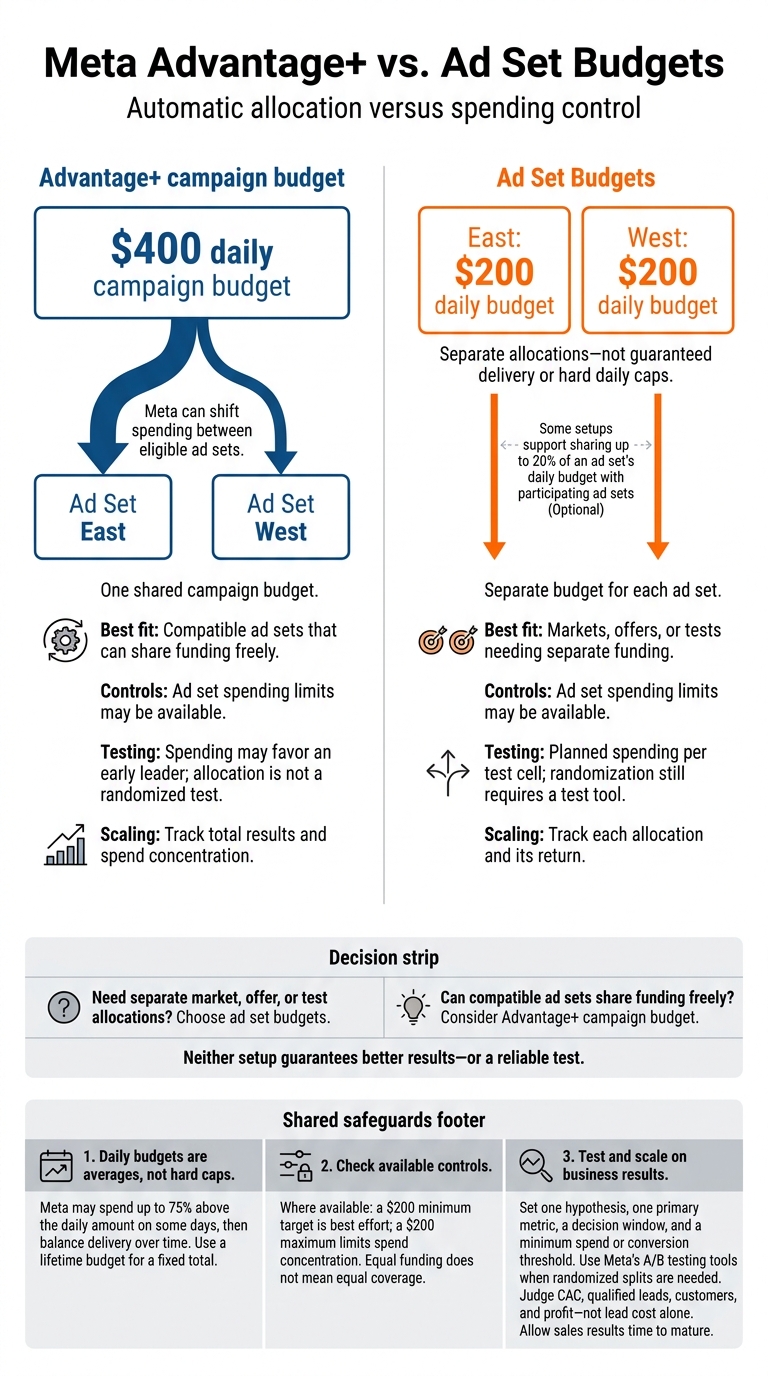
Meta Advantage+ vs. Ad Set Budgets: Allocation and Control
How Campaign and Ad Set Budgets Work
Advantage+ Campaign Budget Automates Allocation
Formerly called campaign budget optimization (CBO), Advantage+ campaign budget uses one daily or lifetime budget for the entire campaign. Meta moves spending across eligible ad sets based on predicted opportunities - it doesn’t split the budget evenly.[3][6][7]
For this to work, the ad sets must be compatible. They usually need the same budget type and bid strategy. With highest-volume bidding, they also need the same optimization event. Check Ads Manager to confirm what’s supported for your campaign setup.[6]
Daily budgets are averages, not hard caps. Meta can spend up to 75% above the daily budget on strong days, then balance delivery over time. A lifetime budget sets the total for the campaign’s run. Some setups also let you set minimum and maximum spend limits for individual ad sets.[2][5][6]
Automation cuts down on manual budget transfers, but you still need to watch performance as you scale your revenue. Start with campaign-level spend, conversions, and returns. Low spend in one ad set doesn’t mean the campaign is failing.
If fixed allocations matter more than moving money between ad sets, ad set budgets keep each audience’s budget separate.
Ad Set Budgets Keep Allocations Separate
With ad set budgets, you give each audience, offer, product, or region its own daily or lifetime budget. This lets you reserve funding for specific markets, offers, or tests as you scale.
These budgets are targets, not guaranteed spend. Small audiences, bid controls, or limited conversion opportunities can leave part of a budget unspent. Different objectives or bidding settings may still call for separate campaigns.
Some setups without campaign budgets also support ad set budget sharing. This can move up to 20% of an ad set’s daily budget to other participating ad sets.[7][8] Compare each ad set’s actual spend with its budget, and review its conversion rate and contribution to revenue.
sbb-itb-db0d145
Spending Control vs. Automated Allocation
The choice comes down to control versus flexibility. Campaign budgets automatically move spend across ad sets. Ad set budgets keep funding separate by market or strategy. Neither guarantees efficiency: the right setup depends on whether each market needs fixed funding or room to shift spend.
Plan Spending for Required Markets
If East and West each need $200 per day, two regional ad set budgets keep the allocations separate. A $400 daily Advantage+ campaign budget allows Meta to shift spending between them. Where available, ad set spending limits can provide a $200 minimum target or a $200 maximum for each region. Minimum targets are best-effort controls; maximum caps limit concentration.[3][7]
Audience size, competition, and delivery eligibility still determine how much each region can spend. Review regional spend, reach, frequency, and conversions together. Equal funding doesn’t mean equal coverage. Check the available controls in Ads Manager before committing to regional spending requirements.[9][10][11]
Budget control only matters if the added spend leads to better business results.
Track Customer Quality and Returns on Added Spend
Judge allocation by customer acquisition cost (CAC), qualified-lead cost, conversions, and profit - not lead cost alone. Compare campaign totals with regional results, then connect Meta’s reporting to CRM-qualified leads, closed customers, refunds, and margins.
Use those results to decide whether to increase the budget, keep allocations as they are, or shift spend. Apply the same checks whether spending is concentrated or budgets stay separate.
Before increasing spend, set a review window that matches your sales cycle. Measure added qualified leads, customers, and profit rather than relying only on campaign averages.
Use the same date range, time zone, and attribution window across reports. Allow time for delayed sales, and reconcile Meta reporting with CRM and offline sales before making large spending shifts.
Testing and Scaling With Each Budget Model
Keep Controlled Tests Separate From Allocation Decisions
Once budget control is set, decide how you’ll test. Planned exposure and automated allocation solve different problems. Ad set budgets reserve spend for each test cell, while Advantage+ campaign budget favors predicted performance.[3][4] An early leader can absorb spend before other variants gather enough data. Neither model makes a test reliable on its own.
Design the test separately from how you fund it. Set one hypothesis, one primary metric, a decision window, and a minimum spend or conversion threshold before taking action. Keep creative, placements, optimization, attribution, and bid strategy fixed unless that’s what you’re testing. Use Meta’s A/B testing tools when you need randomized splits and a clear winner, backed by enough budget and data to support the decision.[12] Separate ad sets alone don’t guarantee randomization or eliminate audience overlap.
Use ad set budgets when test cells need different audience sizes, goals, or bid strategies. Treat low spend as inconclusive. Give lead and sales results time to mature before judging delivery and conversion volume - a few cheap conversions don’t establish a winner.
Once you have a clear winner, consider how to scale it without disrupting the data.
Scale Proven Ad Sets Without Splitting Data
Moving from controlled testing to campaign-level allocation is one option, not a required next step. Before changing the structure, check conversion volume, audience overlap, budget, and whether campaign settings are compatible. Then decide whether more spend calls for separate budget control or shared allocation.
Campaign-level allocation works best with at least two eligible ad sets. But adding more splits thins out the data each ad set can produce. Split only when the difference affects a business decision, such as geography, offer, or required spending control.
Record a baseline before making changes. Then track learning phase changes, spend concentration, acquisition cost, customer quality, and returns on added spend. Restructuring changes delivery conditions, so don’t assume a winner will perform the same way at a higher budget. Keep ad sets separate when you need spending control; use campaign-level allocation when compatible ad sets can share funding freely.
Conclusion: Match Budgets to Business Requirements
Neither model is better in every case. Use Advantage+ campaign budget to shift funding toward total results. Choose ad set budgets when markets, products, or tests need fixed funding.
Add spending limits where available to keep spending within bounds. Separate campaigns when objectives, delivery settings, or spending requirements conflict. Keep the ad sets within each campaign compatible.[5] For a fixed total cap, use a lifetime budget - not a daily budget.[1]
Before changing your budget structure, document required allocations, test thresholds, spend caps, promotion dates, and target CPA or ROAS.[1]
FAQs
How quickly should I increase my Meta Ads budget?
Increase your Meta Ads budget by no more than 10% to 20% every 48 to 72 hours. This helps keep the algorithm working efficiently and avoids restarting the learning phase.
Before scaling, check that your campaign has exited the learning phase, stayed stable for at least seven days, and generates at least 50 conversions per week. Make budget changes early in the day so the algorithm has a full 24-hour cycle to adjust.
When should I switch to Advantage+ campaign budget?
Switch to Advantage+ campaign budget when your campaigns perform consistently and you’re ready to scale. Start with manual ad set budgets to find the audiences and ad assets that work best.
Once your campaign’s return on ad spend (ROAS) beats your target for at least five consecutive days, make the switch. Meta’s AI will then adjust spending across ad sets in real time to optimize overall results and cut down on manual management.
How can I tell if scaling is hurting profitability?
Track 3- to 5-day trends, not daily swings. Calculate your break-even return on ad spend (ROAS) by dividing 1 by your profit margin, expressed as a decimal. Campaigns should consistently stay above that level.
Watch for these warning signs: ROAS staying 40% below target for three or more days, cost per acquisition (CPA) climbing 30–40% above goal, or frequency exceeding 2.5–3.0. These can signal audience saturation and diminishing returns from additional spending.