Why Meta Ads Spend More on 1 Ad During Testing

Why Meta Ads Spend More on 1 Ad During Testing
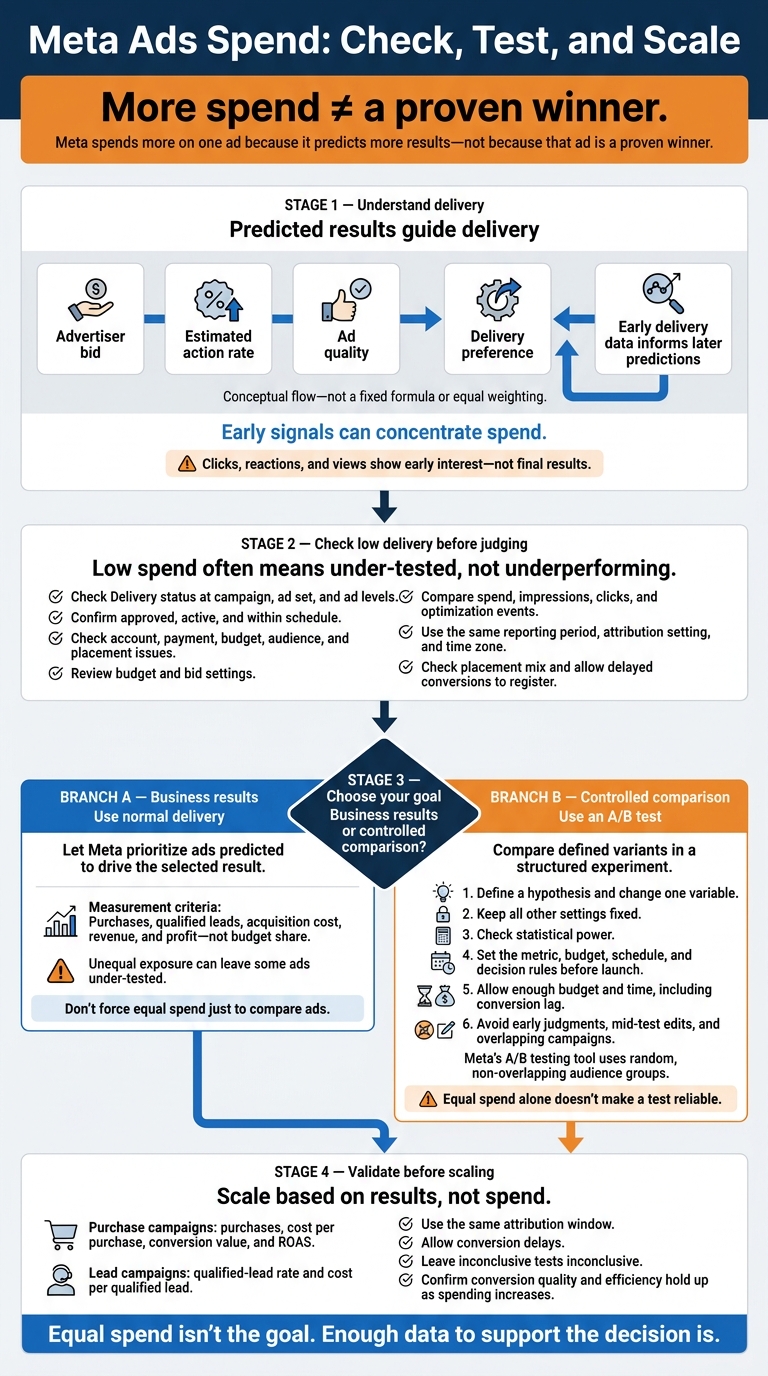
Meta spends more on one ad because it predicts more results - not because that ad is a proven winner. Before pausing ads with low spend, check their delivery status, approval, budget, and bid settings.
Meta’s auction weighs 3 main factors: bid, estimated action rate, and ad quality. Early data can steer spending toward one ad while leaving others under-tested.
- For business results: Use normal delivery and judge purchases, qualified leads, revenue, and profit - not budget share.
- For ad comparisons: Use an A/B test, change one variable, and set the budget, schedule, and decision rules before launch.
- Before scaling: Allow for conversion delays and confirm that results hold up as spending increases.
Equal spend isn’t the goal. Enough data to support the decision is.
Meta Ads Spend: Check, Test, and Scale
How Meta Allocates Spend Across Ads
Meta decides which ad to deliver for each impression opportunity, guided by your selected optimization event. A campaign optimized for landing-page views may deliver differently from one optimized for purchases.[1][6]
Predicted Results Guide Delivery
Delivery follows auction predictions - not a fixed budget split. Meta’s auction weighs three main factors: advertiser bid, estimated action rate, and ad quality. A higher bid alone doesn’t guarantee delivery.[3] Estimated action rate predicts whether a person will take your selected action. Ad quality reflects viewer feedback and low-quality traits, such as engagement bait.[2][4]
These predictions go beyond past conversion rates.[2][3] Meta can draw on signals from your account, events, audience, placements, ad creative, and the context of each impression opportunity. It identifies the main inputs but doesn’t publish a fixed formula explaining each ad’s exact share of spend.[3]
Early Signals Can Concentrate Spend
Meta updates its predictions as delivery data comes in. Early responses can steer spending toward one ad, and each delivery adds data that informs later predictions.[3] But clicks, reactions, and views show early interest - not final results.[2]
Since early spending can shift quickly, judge each ad by the result it’s meant to drive. For purchase campaigns, track purchases, cost per purchase, conversion value, and ROAS. For lead campaigns, track qualified-lead rate and cost per qualified lead. Ad creative fatigue and auction competition can change delivery over time, so the ad getting the most spend today may not stay ahead.[3]
sbb-itb-db0d145
Why Low Spend Does Not Mean Poor Performance
Low spend often means under-tested, not underperforming. Meta’s predictions may favor one ad before others collect enough data to compete. Start by checking whether low delivery comes from the setup rather than the ad itself.
Check Ad Eligibility and Delivery Data
In Ads Manager, check Delivery status at the campaign, ad set, and ad levels. Make sure the ad is approved, active, and within schedule. Look for account, payment, budget, audience, or placement issues that could block delivery.[8]
Compare spend, impressions, clicks, and optimization events over the same reporting period, using the same attribution setting and time zone. Check how delivery splits across placements, and give delayed conversions time to register before judging recent traffic.
If you want to compare ad concepts or assets, normal delivery alone won’t give you a controlled test.
Normal Delivery vs. a Controlled Test
| Approach | Intended purpose | Main limitation |
|---|---|---|
| Normal delivery: optimization | Let Meta prioritize ads predicted to drive the selected result. | Unequal exposure can leave some ads under-tested. |
| Controlled test: measurement | Compare defined variants in a structured experiment. | Requires a clear hypothesis, enough budget, and enough time. |
Normal ad-set delivery doesn’t guarantee equal exposure or isolate differences between ad concepts or assets. Meta’s A/B testing tool uses random, non-overlapping audience groups to help make comparisons more reliable.[9]
Equal spend alone doesn’t make a test reliable. Audience overlap, placement mix, timing, and conversion lag can still distort results. When testing ad concepts or assets, change one variable, keep everything else fixed, and allow enough budget and time for a clear read.[7] Use that setup when the goal is comparison, not just delivery.
Choose a Test Setup That Fits Your Goal
Once you’ve ruled out delivery issues, choose a setup based on what you need: business results or a controlled comparison. Equal spend isn’t the goal.
Use Normal Delivery for Business Results
Stick with normal delivery when purchases, qualified leads, or booked appointments matter more than measuring each ad separately. Judge results by acquisition cost, lead quality, revenue, and profit - not how the budget gets split.
Low spend doesn’t prove an ad is weak. Don’t rebuild a campaign that’s working just to force equal spend. If you need a controlled comparison, use an A/B test instead.
Use an A/B Test to Compare Ad Variants
An A/B test isolates one variable. It helps you compare variants without assuming the ad with the most spend is the winner.
Keep all other settings fixed and check statistical power before launch. Lock in the budget and decision rule, too, so you can interpret the results clearly.
Set the Budget and Decision Rules Before Launch
Before the test starts, set the metric, budget, schedule, and criteria for declaring a winner - or calling the result inconclusive. Base the schedule on expected conversion volume and reporting lag.
Avoid judging results early, editing the test midway, or running overlapping campaigns that split delivery.
Get Help With Unclear Delivery Issues
Dancing Chicken offers Meta Ads consulting, account audits, custom ad design, and testing plans when budget allocation remains unclear, measurement breaks down, or overlapping campaigns blur test results.
Conclusion: Scale Based on Results, Not Spend
Meta favors predicted results over equal exposure. More spend signals a delivery preference - not proof that the other ads failed.[5][2]
Check Business Outcomes Before Scaling
Spend provides context, not the whole picture. Check metrics tied to your goal, such as ROAS, cost per purchase, or cost per qualified lead. Use the same attribution window when comparing results, and remember that results can change as more data comes in.
Treat ads with little data as under-tested, not failed. If a test is inconclusive, leave it at that. Apply what you've learned with care, then track conversion quality and efficiency as spending increases.
Scale only when business results hold up at higher spend. Uneven spending is normal; profitability should guide which ads get more budget.
FAQs
How much data do I need before pausing an ad?
Leave ads unchanged for at least 48 to 72 hours. Early data can mislead, though clicks and reactions may hint at an ad creative’s potential before results reach statistical significance.
Don’t force equal budget splits. Meta distributes spend based on predicted results and early signals. More spending on one ad doesn’t mean the others are performing poorly. Judge each ad alongside the campaign’s overall results.
How can I test ads with a small budget?
Run controlled experiments instead of forcing manual spending splits. Follow the 10% rule: set aside 10% of your total budget to test bold new ideas.
Use Meta's built-in A/B testing tool in Ads Manager to randomly assign people to non-overlapping audiences with an even budget split. Test one variable at a time, such as a headline or image. Let each test run for 4–7 days to collect meaningful data without overspending.
What should I do if my A/B test is inconclusive?
Check that your data is accurate and that you have enough of it. Make sure your metrics match your test goals, review your statistical significance threshold, and confirm that your hypothesis tested one clearly defined variable.
If the results are still unclear, make the differences in design or messaging more obvious, or try targeting a different audience. Review performance by demographics, such as age or gender, to spot patterns that campaign totals may hide.