ABO to CBO: How Testing Shapes Meta Ads Scaling

ABO to CBO: How Testing Shapes Meta Ads Scaling
Use ABO to control test budgets. Use CBO to share spend across ad sets that meet profit targets. Before launch, set a target cost per purchase or qualified lead, a spending limit, and rules for stopping. For example, three ad sets at $50 per day for seven days cost $1,050 - but that spend alone doesn’t prove a winner.
The decision comes down to three checks:
- Test quality: Check tracking, change one variable at a time, and allow for conversion delays. Equal ABO budgets don’t make a test randomized.
- Business results: Judge CPA, conversion quality, and profit - not clicks or a few cheap purchases. Too little data means no decision, not failure.
- Scaling readiness: Move to CBO only when ad sets can share a budget and profit target. Then increase spend in steps and check where the money goes.
Quick Comparison
| Budget choice | Who sets each ad set’s budget? | Best fit | Main risk |
|---|---|---|---|
| ABO | The advertiser | Tests or protected spending | Spreading the budget too thin |
| CBO / Advantage+ campaign budget | Meta allocates a shared budget | Scaling compatible ad sets | Some ad sets get too little spend to judge |
ABO-first isn’t a rule. CBO can be the starting point when prior results support shared spending. If results drop, check tracking, delivery, and conversion quality before blaming the budget setup.
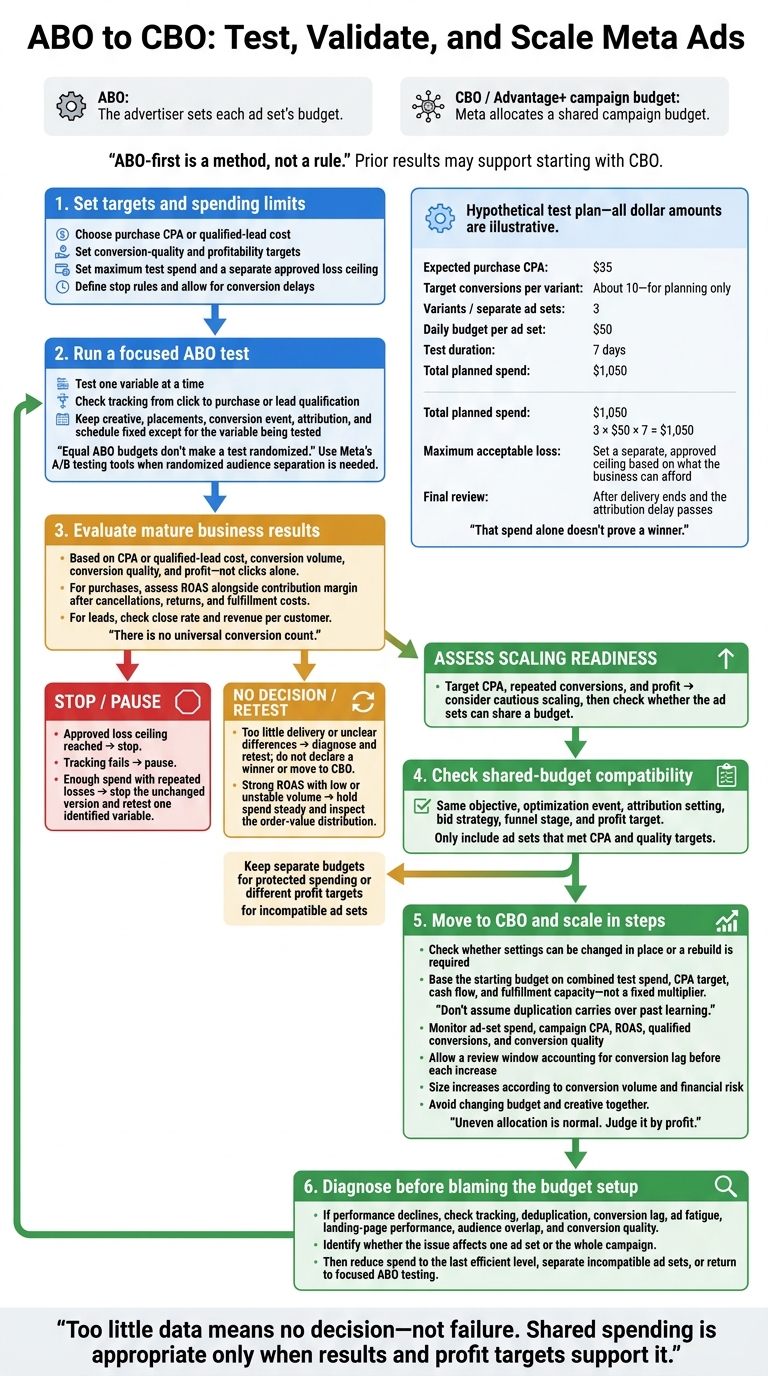
ABO to CBO: Test, Validate, and Scale Meta Ads
1. Choose Where to Set Your Budget
What ABO and CBO Mean
ABO assigns a budget to each ad set. CBO uses one campaign budget and moves spend toward the ad sets Meta predicts will convert best.[1][2]
Equal ABO budgets don’t guarantee equal spend, impressions, or comparable results. Audience sizes, auction costs, and conversion timing can all differ. Test one variable at a time while keeping creative, placements, conversion event, attribution, and schedule fixed.
Compare Budget Control and Delivery
| Consideration | ABO | CBO / Advantage+ campaign budget |
|---|---|---|
| Budget control | You control each ad set’s budget allocation. | Meta decides how much each eligible ad set receives. |
| Variant exposure | You can reserve budget for each variant, though delivery may vary. | Some variants may get too little spend for a fair evaluation. |
| Delivery flexibility | Budget stays at the ad set level. | Budget shifts toward better predicted opportunities in real time. |
| Data concentration | Limited conversion data may be spread across too many ad sets. | Spend and conversion data may concentrate in selected ad sets. |
| Main risks | Too little data or continued spending on weak variants. | Mistaking low delivery for failure. |
Check delivery before judging performance. Review spend, reach, CPM, and primary conversions for each ad set. Low spend in CBO often means you don’t have enough evidence - not that the ad set failed. If every variant needs enough exposure to support a decision, use separate budgets or ad set-level controls.
Neither method wins by default. If conversion volume is limited, simplify the test instead of dividing the same budget among more ad sets. Match your budget setting to the evidence you need.
With the budget structure set, calculate how much each ad set needs before you judge the test.
sbb-itb-db0d145
2. Plan an ABO Test With Spending Limits
Test One Variable and Check Tracking
Write one clear hypothesis for the single variable you’ll test. Before launch, choose purchase CPA or qualified-lead cost as your main metric. Use CTR and conversion rate to help explain the results. Give separate ad sets equal planned budgets, and use Meta’s A/B testing tools when you need randomized audience separation to reduce overlap.[6][8]
Check the entire path from click to purchase or lead qualification. Review UTMs, CRM fields, purchase values, currency, attribution, reporting time zone, and event deduplication. When Meta Pixel and Conversions API send the same event, match the event names and event IDs. Expect some difference between Meta attribution and CRM reporting.[5][7]
Once tracking checks out, size the test so each variant can generate enough data to support a decision.
Calculate Your Test Budget
Complete this worksheet before launch. The budget should help answer one question: Can these ad sets later share spend profitably?
Hypothetical test plan - all dollar amounts are illustrative.
Planning field Hypothetical test plan Expected purchase CPA $35 Target conversions per variant About 10 - for planning only Variants / separate ad sets 3 Daily budget per ad set $50 Test duration 7 days Total planned spend $1,050 Maximum acceptable loss Set a separate, approved ceiling based on what the business can afford Final review After delivery ends and the attribution delay passes
The sample size you need depends on baseline results, variability, and the size of the improvement you want to detect. If the budget falls short, test fewer variants or spread spending over more time, as long as delivery stays sufficient. More time without more total spend doesn’t automatically mean more conversions.
Next, define the cutoff that ends the test.
Set Success Targets and Stop Rules
Use the planned spend to set clear rules for when to stop, scale, or retest.
Stop when you reach the approved loss ceiling, and pause if tracking fails. After the attribution delay passes, consider an ad set for scaling only if it meets your preset CPA or qualified-lead cost, conversion-quality, and profitability targets - with enough evidence to support that choice.
If volume is too low or the differences remain unclear, record no decision and retest. Don’t declare a winner or move to CBO.
3. Decide Whether to Scale, Retest, or Stop
Check Conversion Quality and Profit
Review each ABO ad set’s CPA, conversion volume, conversion rate, and revenue. For purchases, compare ROAS with contribution margin after cancellations, returns, and fulfillment costs. For leads, track qualified-lead CPA through to close rate and revenue per customer. Allow for reporting delays, then compare mature cohorts with the CPA and profit targets you set before launch.[4][10] These checks help you decide whether to scale, retest, or stop.
Look beyond the average. One large order can skew ROAS. A short run of cheap conversions can also hide uneven results. Compare daily or weekly performance and check median order value before scaling. CTR and CPC can help pinpoint friction, but neither proves profitability.[3][11]
Match Results to Next Steps
Use the matrix below to choose your next step. How much evidence is enough? That depends on your margins, sales cycle, conversion frequency, and the financial risk of spending more - not a universal conversion count.
| Observed pattern | Interpretation | Next action |
|---|---|---|
| Target CPA, repeated conversions, and profit | Results support cautious scaling | Scale gradually; assess whether the ad set can work within a shared budget |
| Strong ROAS, but low or unstable volume | Promising, but not proven | Hold spend steady and inspect the order-value distribution before scaling |
| High CTR, weak conversion rate | Clicks aren't turning into business results | Check message match, page speed, checkout or form friction, and tracking; retest a specific fix |
| Enough spend, repeated losses | Results argue against the current setup | Stop the unchanged version; retest one identified variable |
| Not enough delivery | Inconclusive - not a failed marketing idea | Check approvals, audience restrictions, bids, budget, and tracking before retesting |
| Cheap leads, weak close rate | Low cost is hiding poor lead quality | Retest qualification; optimize toward a deeper event where feasible |
Retest a specific fix, not just the hope of a different result. Keep the change isolated where possible. Meta notes that significant edits can restart learning, making frequent adjustments harder to interpret.[9] If an ad set passes these checks, assess whether it can share a budget without losing efficiency.
4. Switch to CBO When Results Support It
Check Whether Ad Sets Belong Together
Once you decide to scale, consider only ad sets that met your CPA and quality targets. Group them only if they share the same objective, optimization event, attribution setting, bid strategy, funnel stage, and profit target.
Keep separate budgets for ad sets that need protected spending or different profit targets. Use ABO to test performance; use CBO when you want shared budget allocation.
Choose How to Switch and What to Spend
Check whether you can change the budget settings in place. Some campaign types require a rebuild. Base your starting CBO budget on combined test spend, your CPA target, cash flow, and fulfillment capacity - not a fixed multiplier.
If you need to rebuild, recreate the tested setup in a separate CBO campaign. Don’t assume duplication carries over past learning. Account for spending shifts and audience overlap while both campaigns run. Budget changes can also affect delivery.
After switching, watch how Meta redistributes spend before increasing the budget.
Track Allocation and Scale in Steps
Review ad-set spend alongside campaign CPA, ROAS, qualified conversions, and conversion quality. Uneven allocation is normal. Judge it by profit, not whether every ad set gets equal spend.
Increase budgets in steps, allowing a review window that accounts for conversion lag before each increase. Base each step on conversion volume and financial risk rather than a fixed percentage. Avoid changing budgets and ad creative at the same time.
Compare Results and Diagnose Declines
Check whether CBO maintained the CPA, ROAS, and conversion quality you saw during testing. Compare ABO and CBO using the same metrics, and note differences in timing, spend, promotions, attribution, and auction conditions. Treat a live ABO campaign as context - not proof that the budget approach caused a difference.
If performance drops, check tracking, deduplication, conversion lag, ad fatigue, landing-page performance, audience overlap, and conversion quality. Find out whether the problem affects one ad set or the whole campaign before acting.
Reduce spend to the last efficient level, separate ad sets that don’t belong together, or return to focused ABO testing. Don’t assume the budget approach caused the decline.
Conclusion: Match the Budget to the Goal
Before launch, set your target event, CPA ceiling, and maximum test spend. Use ABO to test performance, then switch to CBO only when tested ad sets meet profit targets together.
| Approach | Best use | Main risk |
|---|---|---|
| ABO | Control budgets at the ad-set level | Too many ad sets can split delivery and slow learning. |
| CBO / Advantage+ campaign budget | Share a budget across compatible ad sets | Some variants may get too little spend. |
| A/B testing | Test one variable | Requires enough budget, reliable tracking, and enough time. |
ABO-first is a method, not a rule. Let the data guide the move to shared spending. Standard ABO delivery isn't a controlled A/B test, and added spend must still meet your profit target before you scale further.
Dancing Chicken offers Meta Ads audits and consulting for test design and scaling readiness.
FAQs
How can I budget an ABO test with no past CPA data?
Calculate your break-even CPA based on your profit margins. Then set a daily budget that allows each ad set to generate enough conversions - typically 10 to 15 - to judge performance.
Use Meta’s Experiments Tool to estimate the sample size and budget needed for reliable results over 1 to 2 weeks. Give each ad set an equal budget to reduce bias, and use the results to decide where to scale.
How can I tell if an ABO winner is just luck?
Prioritize statistical rigor and consistent results over short-term spikes. Run your test for at least 7 to 14 days to account for weekly patterns, and reach a 95% confidence level.
A winning version should perform consistently across user segments and deliver meaningful business gains, such as higher revenue or lower acquisition costs - not just a small statistical lift. Don’t end tests early; doing so increases the risk of false positives.
When does skipping ABO and starting with CBO make sense?
Starting with CBO can make sense when growth is your priority and you want Meta’s AI to allocate your budget automatically. It works especially well for larger campaigns with enough data to optimize performance, where you don’t need ABO’s ad set-level control.
The usual advice is to test with ABO, then switch to CBO to scale. But starting with CBO can cut manual guesswork by directing budget toward the ad sets most likely to convert.